
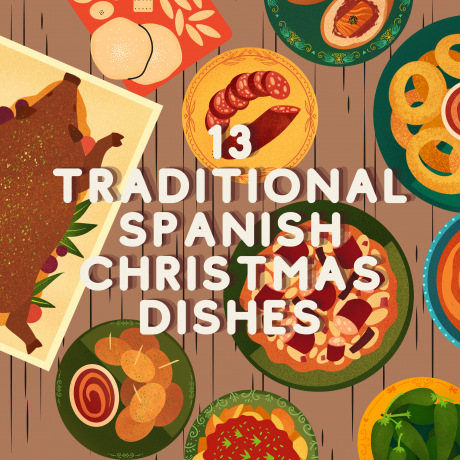
13 traditional Spanish Christmas dishes
The festive period is one of great importance in Spain. There are 5 days of celebrations, with nearly all of them centering around food and spending time with the family. Find out what traditional foods are eaten on these days and where they come from!
Have you ever wondered what a traditional Spanish Christmas meal looks like?

Spain's Christmas traditions are slightly different to other countries, with some varying from region to region! Due to the country's roots in Catholicism, many of these traditions, derive from religious dates or events.
In Spain, the Christmas period begins with the National Christmas Lottery on the 22nd of December and ends on the Dia de los Reyes, on the 6th of December. Throughout this period, food plays a vital role; it brings family and friends together, whilst also celebrating the country's historic culture.
Alike other countries in Europe, Spain celebrates Christmas on the 24th and not the 25th. But still, families continue to come together on both the 25th and the 26th to eat and enjoy each other’s company. In Catalonia, many choose to still eat turkey on the 25th but instead of the classic sides of an English roast, they opt for a more traditional dish – tapas.
Celebrating on the 24th of December has its roots in the Catholic calendar. Traditionally, Catholics would go to the Misa del Gallo, a midnight service to commemorate the birth of Jesus. Due to the importance of this service, many families chose to have their celebratory meal before this, which developed into what it is today. Most Spaniards no longer attend this service, as Catholicism isn't as prevalent as it once was, but the tradition of celebrating on the 24th has since remained.

But what is eaten during this period?
Before we find out about the popular festive foods, it is necessary to mention that they will not be the same throughout the whole of Spain. The regions of Spain all have their traditions and typical foods, so keep in mind that not every one of these dishes will be on every Spaniard's table!
Here are some of the most popular regional dishes that you may find during the Christmas period:
Primer Plato:
Entremeses is a popular dish in all regions of Spain, but the English translation of this word to ‘appetisers’ perhaps gives away what this dish is.
This is typically the first plato of the Spanish Christmas meal, closely resembling a French Charcuterie board, but of course, with a Spanish twist. It is customarily served on a large tray-like dish, consisting of cured meats like jámon, chorizo, y morcilla (black pudding) as well as locally sourced cheeses.
This dish is popular throughout the whole of Spain and is a staple plato on every table, in every region.
However, in Catalonia, Sopa de Galets is arguably the most popular primer plato. This dish is perhaps one of the most comforting on the list. It is a thin meaty broth comprising of galets (pasta shells) often stuffed with meat or left as they are. However, in some households, the meat is served separately, in the form of a large meatball that the whole family can share! Although this soup looks easy to make, it can actually take up to 15 hours! The meat has to be cooked slowly along with other ingredients in order to create aa rich and tasty broth.
Plata principal:
Typically, a turkey would not be the meat found on the table of Spanish Christmas celebrations, as you would find in England or America. Instead, they opt for lighter meat such as seafood like salmon or prawns. This choice is very popular in the coastal regions of Spain, such as Galicia.
But, in the central regions, like Castile and Leon, lamb is a popular choice as a plato principal.
Additionally, a cochinillo (suckling pig) is a beloved dish alongside lamb. This is so popular in fact that many people order their pig months in advance from Valladolid or Segovia. The suckling pig is usually cooked until crispy on top of potatoes and onions so that they are caramelised as the meat cooks.
Much like Christmas meals in other parts of the world, Catalonians also prepare a roast for their main course. However, it is slightly different to that of England or America. Instead of the abundance of food found on the plate in the UK or America, this meal solely consists of chicken, plum and pine nuts. Although simple, it is a light yet flavoursome dish eaten throughout most of Catalonia!
Sarsuela de peix I marisc, or Zarzuela de pescado y marisco in Spanish, is a traditional Catalan dish served as the main course on December 24th, following the Caga Tió celebration. Much like many other Spanish foods, this dish centres around seafood – and a lot of it! Perhaps most similar to the French bouillabaisse, it has a much more 'cosy' feel due to the addition of almonds, tomatoes, pork and ham. It feels more complete and is the perfect wintery meal to enjoy with family. But, of course, in addition to pork and ham, there is seafood. This is a meal made primarily of shellfish, such as prawns, clams and mussels, but other seafood can be added depending on the family's preferences.
And of course, after these delicious mains, there are plenty of traditional sweets to follow!

Marzipan
Marzipan is popular all year round in Toledo but becomes especially popular during Christmas time. Classically made from ground almonds, egg,, and sugar, it is a very sweet dessert that is enjoyed by many during the holidays. But not only does it taste delicious it also can look like art! A lot of the marzipans made for Christmas are molded into distinctive Christmas shapes and are sometimes used as decorations themselves!
Polvorones and Mantecados
These sweet treats are very similar to each other and can often get confused. Both are sweet wheaty biscuits that are popular around Christmas, but the process of making them differs. Additionally, polvorones are a type of mantecado but are usually only eaten at Christmas whereas mantecados can be eaten all year round.
To count a biscuit as a mantecado, it must be made from wheat or almond flour. However, the key defining feature of these biscuits is that the flour is not toasted. To complete the recipe, an egg or only egg whites are mixed into the flour, as well as granulated sugar; the type of sugar is also important!
Polvorones are made of both wheat and almond flour, but the flour is toasted before it is mixed with the remaining ingredients.
Additionally, instead of granulated sugar, icing sugar is used, and there are no eggs in this mix – egg whites, or otherwise! Because of these differences, these biscuits need less time to bake which is what gives them their classic crumbly texture. Remember to always wrap these in paper so crumbs don't go everywhere!
Roscos de Vino
At first glance, Roscos de Vino look like doughnuts, with their icing sugared coating concealing their crumbly texture. These biscuits are made using flour, sugar, olive oil, lemon zest, ground sesame seeds and Anisette liqueur. But, most importantly and where they get their name from, is the addition of a dash of sweet wine that also goes into the mixture. These biscuits are very sweet but still delicious and are commonly enjoyed after a large Christmas meal!
Neules
These sweet biscuits are most similar to the wafer biscuits found in English deserts, however, instead of ice cream, they are dipped in cava! Additionally, the Catalonian counterpart also has an added ingredient - lemon! This addition creates a light and delicious paring to the popular alcoholic drink! But, you need to be careful not to drop these fragile biscuits into your drink after dunking!
Tronc de Nadal
This dessert is similar to the chocolate log found in the UK, however, it is possibly more suited to the Catalonian culture. As this isn't the only log present in Catalonian celebrations, it feels as though it fits better. The Caga Tió, a log figure hit by children on Christmas Eve, is a lengthy tradition. As if being hit and thrown into the fire wasn't enough, Catalan families make an edible replica to eat after their Christmas Eve meal! The popularity of logs in Catalonian culture is odd, but with delicious desserts like a chocolate log, no one can complain!
Like many other celebrations, the Christmas festivities are almost always fully enjoyed with a glass of cava in hand!Like many other celebrations, the Christmas festivities are almost always fully enjoyed with a glass of cava in hand!